Monday, June 21, 2010

'The Girl Who Kicked the Hornet’s Nest' by Stieg Larsson


I’m sure that anyone who has heard anything about the final installment in Stieg Larsson’s trilogy has heard nothing but good. And rightly so. The Girl Who Kicked the Hornet’s Nest is a satisfying conclusion that resolves many of the complex issues that Larsson created. This book is certainly not for you if you haven't read the first two books of the trilogy - they are not stand-alone books.

When the Girl Who Played with Fire concluded, Lisbeth Salander was in a dangerous situation, physically and legally. The Girl Who Kicked the Hornet’s Nest is the story of Lisbeth’s recovery and the investigation of her supposed crimes/offenses. Of course, Mikael Blomkvist is still Salander’s greatest advocate; he helps to track down and unravel the conspiracy that caused her to be abused and declared legally incompetent.

Stieg Larsson has posthumously proven himself to be one of the most talented suspense writers of our time. Even though Larsson died before the publication of his books, they are certainly not unfinished. All three books were delivered for publication prior to Larsson’s death, and I can’t think of anything that is missing. The trilogy is great for suspense readers, but also for those who simply enjoy a good book.

Monday, June 7, 2010

‘The Guernsey Literary and Potato Peel Pie Society’ By Mary Ann Shaffer and Annie Barrows

The Guernsey Literary and Potato Peel Pie Society is set in England shortly after World War II. The main character is an author trying to decide on a topic for her next book; she had been writing satirical commentary on the war until recently. A letter arrives from a stranger who lives on the channel island of Guernsey, and they begin to correspond. Though the entire story takes place during 1946, the lives of the island inhabitants haven’t really moved past the German occupation. The people still show signs of being deprived of life’s comforts, and friends and family members haven’t all returned to the island. Even though it is a wonderful story about friendship, reading, love and family, the book also serves to illustrate how long tragedy stays with a community.

This book is written in a very interesting (though certainly not unheard of) style. The narration comes in the form of letters written between the characters, and there isn’t any actual narrator at work. I should say that the narration comes from selected letters, because not all of the characters’ correspondence is included; there are references to events and conversations that we don’t hear of firsthand. I enjoy this; I feel that readers and authors are hesitant to leave anything to the imagination, which is what fiction is supposed to be all about. Happily, Shaffer and Barrows were able to omit letters that they did not deem necessary without leaving anything wanting in the story.

Monday, May 24, 2010

The Legend of Zelda Fitzgerald


It seems that people think about Zelda Fitzgerald a lot less often than they did in the 1970s, when I first read Nancy Milford’s biography, Zelda (PS3511 .I9234 Z8 1983). Perhaps more than 60 years after her death, it’s just too hard to imagine anyone like Zelda anymore. Perhaps her story seems just too sad, today, to tell that much.

Known her beauty and vivacious personality, Zelda married F. Scott Fitzgerald when she was 19. Scott was already a successful writer, and the couple lived on about $20,000 a year at a time when the average annual income was less than $1,000. They had a lot of fun—drinking, dancing on tables, traveling—for awhile. Their marriage deteriorated. Ernest Hemingway suggested that Zelda was jealous of Scott’s success, and Scott was jealous of Zelda's possible interest in other men. At age 27, Zelda wrote and painted, and was very serious about ballet. However, 27 is too late to begin a dancing career. Scott attributed her first mental breakdown, where she heard voices and had waking dreams of phantoms and other horrors, to excessive devotion to dance. After 1931, Zelda spent as much time in asylums and sanitariums as she did with Scott and later with her mother in Alabama. She died horribly in 1948.

It seems likely that Zelda’s illness would have a bad outcome even today. However her diagnosis and treatment would have been different. When she left an asylum after a year and three months’ visit in 1931—it’s hard to imagine anyone staying in an asylum for that long today—“her case was summarized as a ‘reaction to her feelings of inferiority (primarily toward her husband). . . She was stated to have had ambitions which were ‘self-deceptions’ and which ‘caused difficulties between the couple.’” The doctor’s idea was that if Zelda could get rid of her artistic ambitions, her prognosis for full recovery was good.

While in the institution, Zelda wrote an autobiographical novel, Save Me the Waltz. When Scott read it, he became furious, because he had been using the same events from Zelda’s life in his own novel. The idea seems to be that because he was the better writer, he deserved the material. He forced Zelda to eliminate scenes similar to those he had in mind for Tender is the Night. There is no doubt that F. Scott Fitzgerald was a vastly better writer than Zelda—but does that mean she should lose the right to document her own life?

What can we learn from Zelda Fitzgerald’s sad life? That you can go from the top of the world to somewhere near the bottom awfully quickly? That doctors do not have all the answers? Zelda is an engrossing, thoughtful, and perhaps cautionary read even for those not interested in the works of F. Scott Fitzgerald.

Wednesday, May 12, 2010

Moo

Perhaps because most of my jobs have been at colleges, I usually enjoy reading fiction about them. Moo (PS3569 .M39 M66 1995) is a very funny novel by Jane Smiley about a school that sounds a lot like the University of Iowa or Nebraska. Unlike Southwestern College in almost all ways, Moo U incorporates the state's agricultural school, which explains the secret presence of a hog, the victim of a rogue experiment, growing larger every day in a closed-up building called Old Meats. We get to see into the minds of about 100 different characters--including the pig's--and it's a testament to Jane Smiley's skill that we hardly ever get them mixed up.

Only a few of the characters are evil, but quite a few are eccentric, from the dean of the agricultural school (who plans to marry a cafeteria worker and get her pregnant through "artificially induced multiple births" that will "bring science into the service of the greater glory of god") to the paranoid farmer (who hangs around the dean's office wearing a bulletproof vest to protect himself from "the FBI, the CIA, and the big ag businesses, all of whom ... wanted to get him out of the way before he perfected and marketed his invention").

Although their courses are pretty different from what Southwestern students take, the Moo U. students' concerns are pretty similar: grades, finances, family, jobs, social lives, illness, psychological issues. Will the four roommates whose freshman year we follow return next September as sophomores? How will Moo U. react to the state's budget cuts? What will happen to the world's largest pig? Anyone with a sense of humor or an interest in academic life would probably enjoy finding out.

Wednesday, May 5, 2010

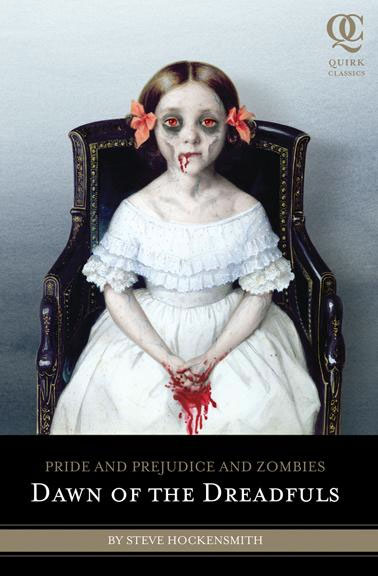
'Pride and Prejudice and Zombies: Dawn of the Dreadfuls' by Steve Hockensmith

The first Pride and Prejudice and Zombies book had the advantage of being able to use Jane Austen’s own language and storyline – just add zombies. The prequel, Pride and Prejudice and Zombies: Dawn of the Dreadfuls, does not enjoy this same advantage. The author, Steve Hockensmith, created the story using many of Austen’s characters, without Austen’s famous wit to animate them. Oh well.

That said, those who enjoyed Pride and Prejudice and Zombies will probably enjoy Dawn of the Dreadfuls. The book is fun and zombie-filled; including more of those sexual references and innuendos that would surely make Austen blush (or worse). In my humble opinion, it wasn’t quite as good as the first, but really, people who read these books aren’t really looking for good writing. Or at least, hopefully they are not.

Tuesday, April 6, 2010

The Girl who Played with Fire By Stieg Larsson

Of course, I wouldn’t have read The Girl Who Played With Fire without first reading The Girl with the Dragon Tattoo. I can happily report that I have enjoyed The Girl Who Played with Fire as much or more than the first installment in the series. The original book featured recent crimes and not-so recent crimes, and we certainly get more of the same in this book.

One of my favorite things about the first book is that it was an investigation into a mysterious crime from many years ago. My favorite thing about this book is that Investigators Blomvkist and Salander are more personally involved in the investigation that takes place. Though Blomvkist is technically working on articles for his news magazine Millenium, he contributes the amount of energy that he does because of his personal involvement. Larsson successfully creates suspense right to the last page.

I suspect that people who enjoyed The Girl with the Dragon tattoo will enjoy this book as well; there is much to be said for reading the first book before starting this one. As with any series, there is catch up information for those who didn’t read the book, or who haven’t read it recently, but Larsson builds on many relationships that were established in the first book. In my opinion, this would be quite confusing if you haven’t read The Girl with the Dragon Tattoo.

Normally, I don’t read many suspense/thriller novels, even though I typically enjoy them. The fact that this series is a bit of a sensation has attracted me though. I recommend the book, and I’m looking forward to The Girl who Kicked the Hornet’s Nest.

Thursday, March 18, 2010

The Girl with the Dragon Tattoo by Stieg Larsson


I feel like I must have been the last person to read The Girl with the Dragon Tattoo; I heard good things about it from both my parents and my advisor on my Master’s thesis. So writing about it feels very unoriginal. Yet here I sit, writing about it.

The Girl with the Dragon Tattoo is a wonderful suspense story about an unlikely pair investigating an old missing person case. A middle aged journalist who was recently convicted of libel partners with an unpredictable, punk private investigator. The two are trying to find an explanation for the disappearance of a teenage girl from a seemingly isolated island in the 1960’s.

Of course, the key for any suspense writer is to arrange circumstances and characters so that the solution to the mystery isn’t obvious. Larsson has created a cast of characters diverse enough to keep us guessing without making it confusing. (Though, as this book was originally written in Swedish, there are far more surnames beginning with “Bj” than the average American is used to).

One of my favorite things about this book is the fact that although the translation is excellent, there are still occasional spots where the wording seems a bit strange. Perhaps this is because I enjoy the foreignness of it. There are points that seem like a dubbed movie - you can tell that it isn’t really what the characters are saying, but it doesn’t matter. Whether you find these slightly awkward phrases charming or not probably won’t make much difference in the end; it’s a clever book that most will enjoy.